
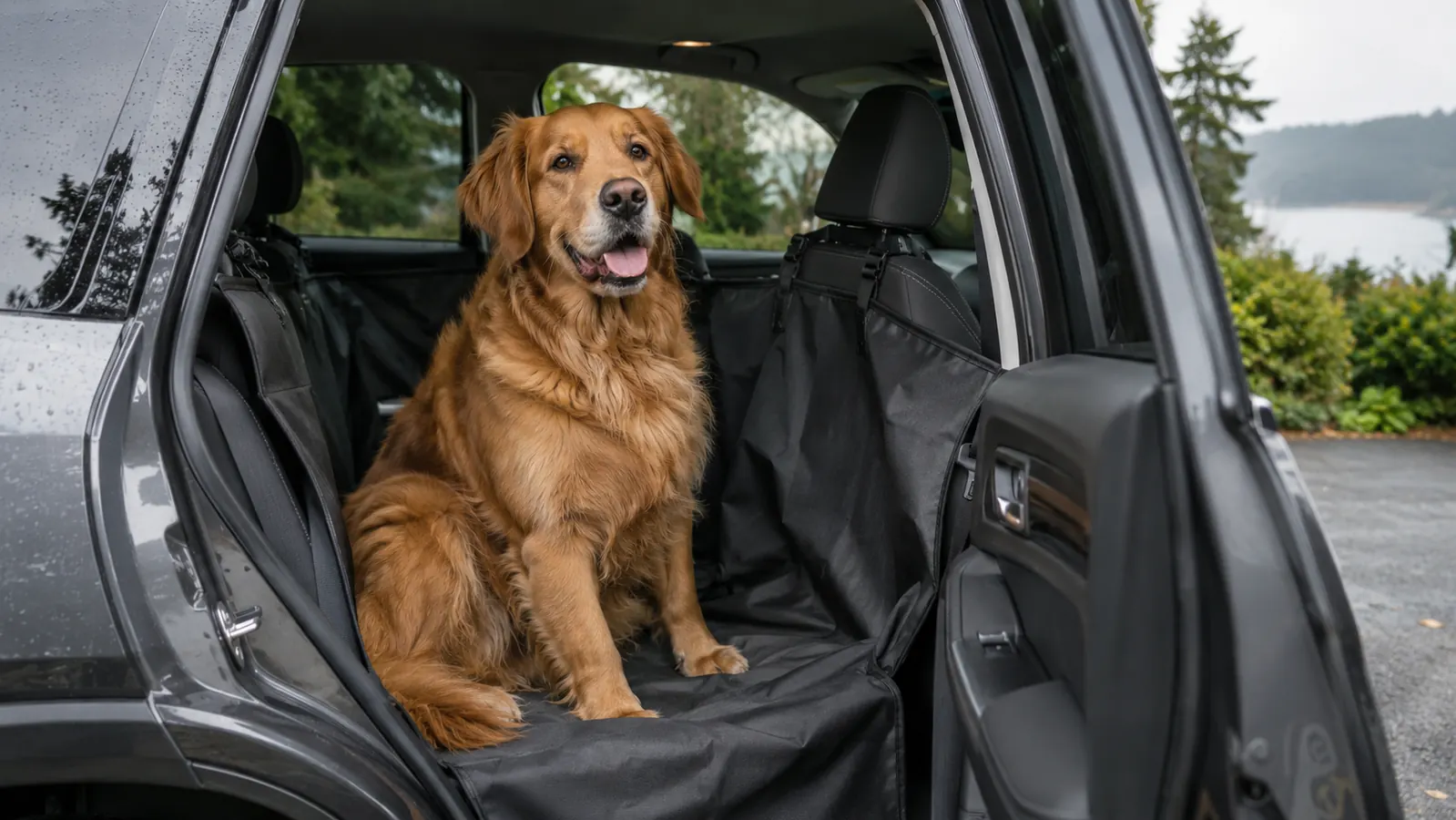
I'll say it straight: by the time Juno turned five, I had stopped pretending my back seat was part of the car. I'm Mark Ellison, a retired mail carrier in Tacoma, Washington, where it rains from October through May. Juno is a 62-pound mixed breed with a short coat and a dense undercoat that sheds year round, and she treats the wet back yard like a swimming pool. After one trip to the lake, the back seat looked like a crime scene: mud streaked across the upholstery, hair ground into the fabric, and a damp dog smell that no air freshener could touch. I tried the obvious fixes first. A beach towel draped over the seat lasted one trip before it slid into a heap. A rubber floor mat kept the carpet clean but did nothing for the seat itself. After I retired and had more time to actually pay attention, I got serious about finding something that worked. The URPOWER Dog Car Seat Cover has been on my back seat for nine months now, and this is the system I would hand to anyone fighting the same fight.
One honest note before the steps. No cover turns a muddy dog into a clean dog. The dog is still muddy when she hops in. What the right cover does is contain the mud, the wet, and the hair so you clean the cover instead of the upholstery. The URPOWER cover does that well, and it has a couple of flaws I will point out as we go. Here is the whole routine, from the back door of the house to the door of the car, in five steps. This is not a spec sheet. This is what I actually do, every trip, and what I would tell a neighbor who asked the same question.
Start with the cover that actually stays put
The URPOWER Dog Car Seat Cover is a waterproof hammock, not a draped blanket. It anchors to the front and back headrests, so it stays where you put it instead of sliding into a pile on the first corner. That one feature is why the rest of this routine works.
Amazon Check Today's Price on Amazon →Step 1: Buy a hammock, not a flat cover
Most people buy the wrong thing first. They get a flat cover that lays over the seat, the kind that looks like a fitted sheet. It covers the cushion but leaves the gap between the seat and the backrest wide open, which is exactly where wet dogs wedge themselves. The URPOWER cover is a hammock. It stretches from the front headrests to the back headrests and creates a cradle across the whole back seat. When Juno climbs in, she stands on the hammock, not on the upholstery. One warning about sizing: the hammock needs enough room to stretch between the front and back headrests. In my car it fits fine, but I have seen people try to force it into a tiny coupe and end up with a sagging middle that the dog sinks into. Measure the distance between the headrests before you order, and if the cover looks tight, go up a size.
The hammock shape does two things a flat cover cannot. It blocks the gap behind the seat, so mud and hair stop collecting in that no man's land where the seat meets the backrest. And it keeps the dog from dropping into the foot well, which means the floor mats stay cleaner too. The side flaps come up over the door edges, so muddy paws do not drag across the door panels when she climbs in and out.
Waterproof matters more than people think. A wet dog soaks through an ordinary fabric cover in minutes, and once the seat foam is wet, it stays damp and sour for weeks. The URPOWER cover is advertised as 100 percent waterproof, and in nine months of Pacific Northwest rain, nothing has soaked through. That is the whole ballgame for me.
Step 2: Install it right the first time
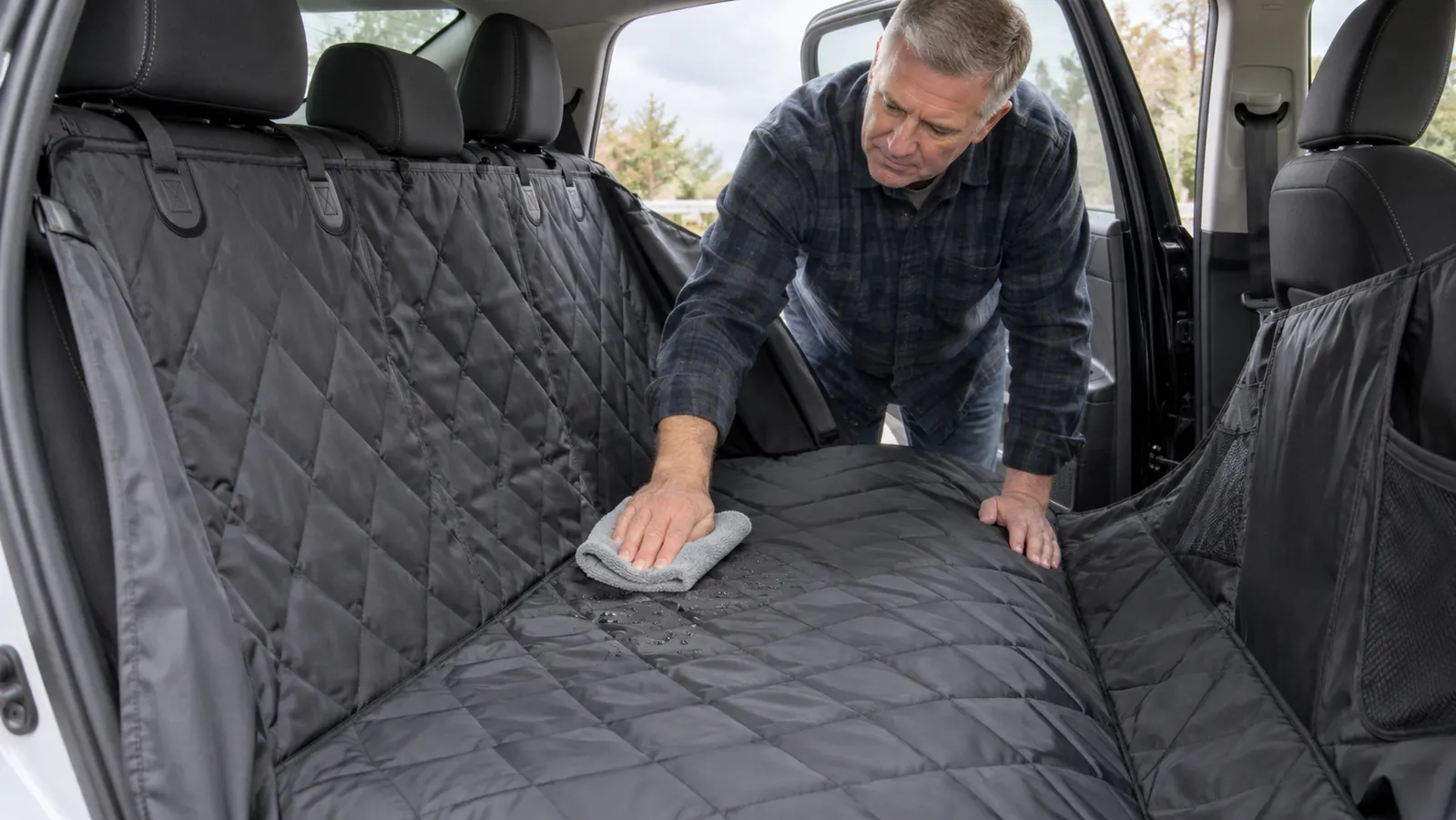
The first install took me about ten minutes, mostly because I did it backwards the first time. The straps loop over the headrest posts, front and back. You want the cover pulled snug, not hanging loose. A loose cover shifts when the dog moves, and a shifted cover leaves a strip of upholstery exposed exactly where the dog will sit. I pulled the straps tight, buckled the quick-release clips, and checked that both side flaps were covering the door edges. One install tip I learned the hard way: pull each strap through its buckle and then tug it to check. A strap that looks buckled but is actually caught on the edge of the headrest will pop loose on the first bump. Ten seconds of checking saves you from watching the whole cover slide into the foot well on a highway ramp.
The other thing to do at install is find the zippers. The URPOWER cover has openings that unzip so the seat belts stay usable. If you carry passengers in the back, unzip those, route the belts through, and zip around them. It takes an extra two minutes and it means you do not have to choose between a clean seat and a buckled passenger.
Once it is tight, leave it in place. The cover is meant to live in the car. I take mine out only for a deep clean, and that has happened exactly once in nine months. Set it and forget it.
Step 3: Dry the dog at the door before she jumps in
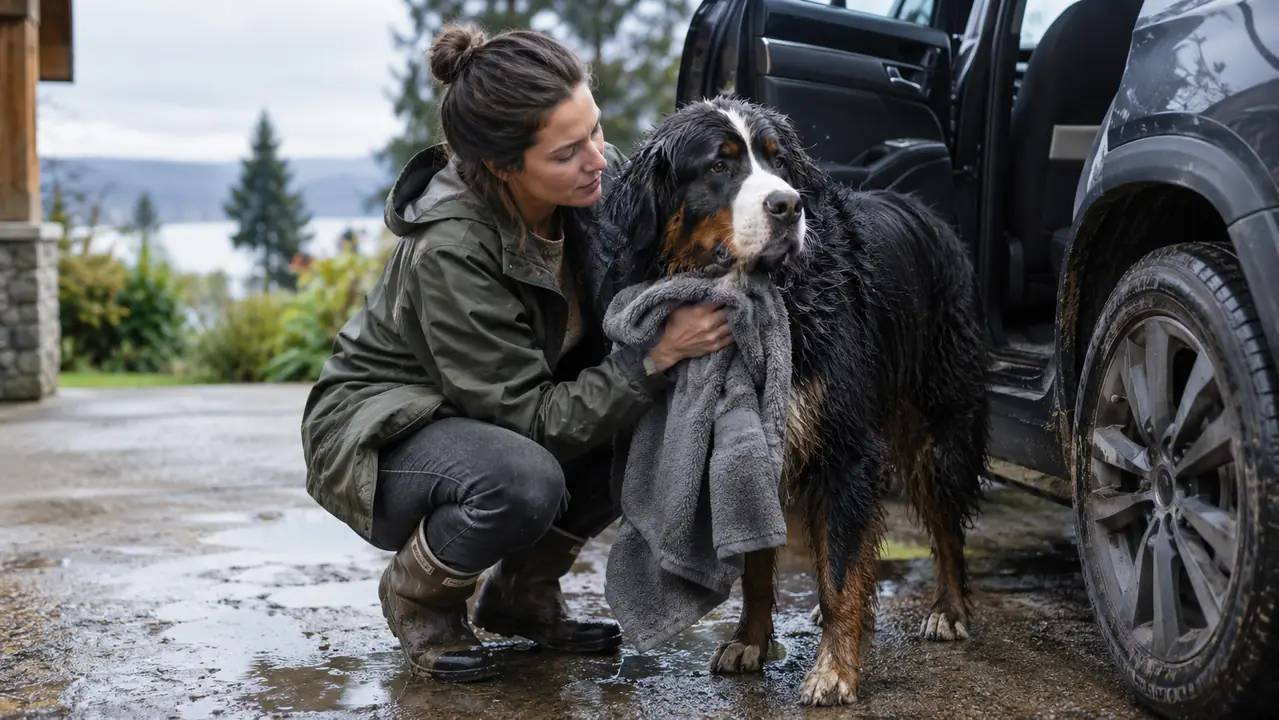
This is the step nobody wants to hear because it is boring. Keep a towel by the back door. When Juno comes in from the yard, she gets a thirty-second rubdown before she is allowed near the car: paws, belly, and the base of the tail. It does not make her dry. It cuts about eighty percent of the water and the worst of the mud, and that is enough to turn a disaster into a mess you can wipe off the cover in two minutes.
I keep a second towel in the car, in a small plastic bin with a leash and a couple of poop bags. That way the routine works the same at the trailhead as it does at home. She gets dried at the door of the car before she gets the command to jump in. Same ritual every time.
Does it feel like a lot of fuss? Yes. Does it save the cover from getting absolutely hammered? Also yes. The towel is the cheapest piece of gear I own and it does more work than anything else in the car. I will add one thing about car sickness, because it is common and nobody warns you. A waterproof cover is the right tool for that too. It is much easier to wipe down a cover than to scrub a mess out of a seat seam. If your dog gets carsick, this style of cover is worth it for that reason alone.
Step 4: Load the dog so the mud stays in the hammock
Here is the thing nobody tells you about a back-seat cover: the dog still has to get in and out, and that is where most of the mess escapes. I taught Juno to wait at the door until I open it, then jump straight into the back. The hammock catches her. The side flaps catch her paws on the way in. The mud that used to end up on the door panel now ends up on the flap, which wipes clean.
If your dog is small or old, help them in. The hammock sits higher than a bare seat, so a little dog or a dog with bad hips might need a boost. That is fine. The point is to get them in one smooth motion instead of letting them paw at the door and track mud down the side of the car.
And if your dog likes to climb into the front, tether them or use the hammock as a barrier. The wall of the hammock behind the front seats is a pretty good fence, but a determined dog can get over it. A seat belt tether solves that in one click. The whole routine takes about a minute once it becomes habit. Towel at the house, towel at the car, open the door, load the dog, go. After the first month I stopped thinking about it. The proof is that I do not dread trips to the lake anymore, and neither does she.
Step 5: Clean up in five minutes, not an hour
The payoff for the whole system is the cleanup. Because the cover is waterproof, mud sits on the surface instead of soaking in. I keep a microfiber cloth and a spray bottle of plain water in the car. When the cover is dirty, I wipe it down. The whole thing takes about five minutes, and the car looks like nothing happened.
When it gets properly filthy, like after a beach trip, I unhook the quick-release buckles, take the cover out, hose it down in the driveway, and hang it over the fence for an hour. It dries fast. I have machine washed it once in nine months, and I would do that sparingly because I do not want to wear out the waterproof layer faster than I need to.
Compare that to the old routine: scrubbing upholstery, vacuuming hair out of the crevices, and driving around with the windows down for a week. I will take the five-minute wipe down. One more cleanup tip: hang the cover to dry in the shade, not the dryer. The waterproof layer does better when it dries slowly, and the sun fades fabric over time. Mine lives on the fence for a few hours after a hose-down and goes back in the car the same day.
What Else Helps
Three things make the cover work better. First, a rubber mat on the floor under the hammock. The hammock catches most of the mess, but a little water finds its way down, and a rubber mat is easier to hose off than carpet. Second, keep a second towel in the car. I mentioned it in step three, and I mean it. You never know when the dog will find a puddle you did not see. Third, trim the dog's nails. Long nails snag fabric, and a snag in a waterproof cover is the beginning of the end for it.
One more thing that surprised me: the cover is awkward to put on a car with headrests that do not come off. Most cars are fine. A few are not. Check that your headrests have posts you can loop a strap around before you buy. It saves a lot of frustration.
Pepper, our cat, has never once ridden in the car, so I cannot tell you how this cover handles cat hair. I can tell you the dog hair situation is handled, and cat people will have to run their own test.
I have washed the cover exactly once in nine months. Everything else was a damp cloth, a hose, and a hang over the fence.
Nine months of muddy hikes, one clean back seat
The URPOWER Dog Car Seat Cover is the reason my upholstery still looks new after a year of Juno. It has flaws, and I named them. But for the current price and the five-minute cleanup, it is the piece of gear I would buy again without thinking.
Amazon Check Today's Price on Amazon →